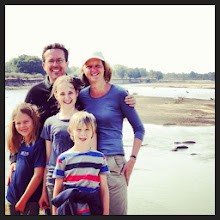
De verhuizing zit erop. Wat verzamelt een mens toch veel. Of anders gezegd wat lijkt het veel als het moet worden verhuisd. De laatste dagen in Dakar kunnen we bij Magali logeren. De kinderen, met name Thomas (dan had ik juist niet verwacht), heeft het erg moeilijk met alle veranderingen. Zijn ogen rolden bijna uit zijn hoofd toen hij al onze spullen in dozen zag. Bij Magali wil hij Sophie niet laten gaan en als ze weg is is hij ontroostbaar. Uiteindelijk valt hij tussen zijn twee zussen in slaap. Voor Sophie en Daniel die beide acht jaar voor ons werkten is het afscheid ook erg emotioneel.
zaterdag 21 juni 2008
Verhuizing en tranen
De verhuizing zit erop. Wat verzamelt een mens toch veel. Of anders gezegd wat lijkt het veel als het moet worden verhuisd. De laatste dagen in Dakar kunnen we bij Magali logeren. De kinderen, met name Thomas (dan had ik juist niet verwacht), heeft het erg moeilijk met alle veranderingen. Zijn ogen rolden bijna uit zijn hoofd toen hij al onze spullen in dozen zag. Bij Magali wil hij Sophie niet laten gaan en als ze weg is is hij ontroostbaar. Uiteindelijk valt hij tussen zijn twee zussen in slaap. Voor Sophie en Daniel die beide acht jaar voor ons werkten is het afscheid ook erg emotioneel. 

zondag 8 juni 2008
Leaving Senegal behind

We settled in Dakar in 1999 when the country prepared presidential elections that were held in 2000 and which saw the end of 40 years socialist reign and 20 years of Abdou Diouf presidency. At that time we lived in Point E, just opposite the house of Abdoulaye Wade, the most prominent opposition leader who would be elected president in 2000. Every evening we witnessed the large gatherings in front of his house and the spirit of change (sopi) was really in the air. People and especially youth were extremely hopeful about this change and expectations were high about Wade’s capacity to tackle high unemployment rates in particular. We observed something really special happening in this country, and this positive ambiance (le Sénégal qui gagne) lasted until the 2002 world soccer championship in Korea/ Japan when, very symbolically, Senegal surprised everybody by going to the quarterfinals.
Now we are in 2008 and we have to admit that we leave Senegal at a time when the situation is deteriorating in several respects. Politically : all elections held since 2002 have been heavily contested, Constitution changed at least 20 times, the turnover rate of Ministers and Prime Ministers is very high, power has been progressively centralised at the Presidency, and the impartiality of Justice is not always as clear as one would expect. Economically : economic growth rates decline, as a result of ambitious public spending on what many consider as non priority issues – public finance is in bad shape, disparities between rich and poor increase, and despite the prevailing discourse, Senegal is not able to attract foreign investment in sectors which benefit employment. Socially: many families still confront the daily difficulty of making ends meet, many families depend largely on migrant remittances, criminality is on the rise in urban areas especially, and unemployment remains high.
In addition, just as many other countries Senegal has had to deal with sharp increases in food prices (rice in particular). In combination with two years of disastrous harvests this has resulted in social tension. The deficit in local food production is as much the result of shortage and unpredictability of rainfall as of the absence of agricultural policy. Today, in many parts of rural Senegal, those families that cannot benefit of any form of social solidarity at family or community level are forced to reduce food consumption and eat only one meal a day. The situation is expected to get worse because the traditional food deficit season (just before the next harvest) has only to start. In order to maintain an image of emerging country (le Sénégal qui gagne) Government is reluctant to admit that the situation is alarming. Unfortunately, it is.
To us, Senegal will always remain a beautiful, fascinating and diverse country with a rich cultural heritage and a highly creative and innovative population very much attached to its traditions. A country with a religious capital (Touba) which keeps its status of village but which today has a population of over a million. A country which has so fascinatingly mixed religion (Islam) and tradition, religion and politics, religion and economy. A country, which has a Diaspora on each continent and which at the same time is a destination for many African attracted by the traditional Islamic brotherhoods in the country.
Yet, it also remains a country of contradictions and contrasts. The fast-going and rich urban cultural life of downtown Dakar compared to life in other parts of the country. The extent to which people are global citizens (Senegalese migrants can be found everywhere in the world and they continuously seek new destinations) compared to the importance they attach to their own customs and traditions (there is nothing better than rice and fish, ceebu jën). The extent to which Government is contested and criticised by certain categories of the population (press, teachers, formally employed middle class, intellectuals, etc.) compared to the rate at which president Wade was re-elected last year (even when fraud is accounted for). The innovativeness and richness of local and community initiatives compared to the far from successful implementation of Government policies to create conditions under which these initiatives could flourish. The invitation for 100 people to assist the signing of the president’s new biography in Paris compared to almost continuous strikes in the education sector as a result of which children have not learned much this school year.
We're heading east!
 Since we took the decision to leave our dear Senegal for Vietnam, the last couple of weeks were really all about “the last time we ….”. This reminded us of our departure in 2003; trying as much as possible do things one more time while taking care of all the organisational aspects related to moving to another country. And with the date of leaving fast approaching, 14 June (!), we realise that this is a major event for the children as well. Especially for Noa who has been sad at times about having to leave behind all her friends. At the same time, Noa is as always positive about the future and she has been looking into her atlas about Vietnam.
So now we enter our final week. Our belongings will be moved next Wednesday and then we will stay at the house of Magali, a Belgium friend who came to Dakar from Hanoi! We leave Dakar next Saturday. Lieke, Noa, Annique and Thomas will stay in Arnhem, The Netherlands, and Paul will continue directly to Hanoi. From 20 July, Paul will also be in The Netherlands and on August 10 we will travel all together to our new destination Asia.
Noa's laatste verjaardagsfeest in Dakar

Dit weekend vieren we Noa's feestje samen met haar vriendin Estefania. Na de cake bij ons thuis nemen we de meiden en jongens mee naar Magic Land: een pretpark hier in Dakar waar Noa heel graag haar laatste verjaardag in Dakar wil vieren.
Ondanks de grote hoeveelheid kinderen is het een zeer relaxte verjaardag daar ze zich zelf prima vermaken in de botsautootjes, draaimolens en meer van dit soort ongein.
Ondanks de grote hoeveelheid kinderen is het een zeer relaxte verjaardag daar ze zich zelf prima vermaken in de botsautootjes, draaimolens en meer van dit soort ongein.
zondag 25 mei 2008
Swingend afscheid van Dakar

Er is een tijd van komen en een tijd van gaan. Voor ons is de tijd van gaan helaas aangekomen. Omdat we Henk en Mique graag bij ons feestje wilde hebben, vierden we het al in Mei. Henk en Mique en hun vrienden Herman and Gerda waren fantastische hulpen. Meer dan zestig mensen aten en genoten van de live muziek dankzij de band band van Mo en dansten op de geweldige muziek van DJ Tamsir.
Hoezo is rekenen saai?

Noa and her classmates, stars of the multilplication rap! See also:
vrijdag 25 april 2008
Thomas twee jaar oud!

Vandaag vierden we Thomas zijn tweede verjaardag met zijn playgroup! Na happy birthday en joyeux anniversaire gezongen te hebben, zongen we uiteraard ook nog het lang zal hij leven. Alleen waren we vergeten dit met Thomas te oefenen, dus bij de hiep hiep hoera keek hij vrolijk rond, maar wist niet dat hij in de Nederlandse traditie geacht wordt zijn handen in de lucht te steken. Ja, ja er komt heel wat bij kijken bij het opvoeden van kinderen in het buitenland. Het uitblazen van de kaarsjes daarentegen ging perfect. De taart stond nog niet op tafel of ze waren uit. De kinderen smulden van mijn zelfgebakken chocoladetaart.
Abonneren op:
Posts (Atom)